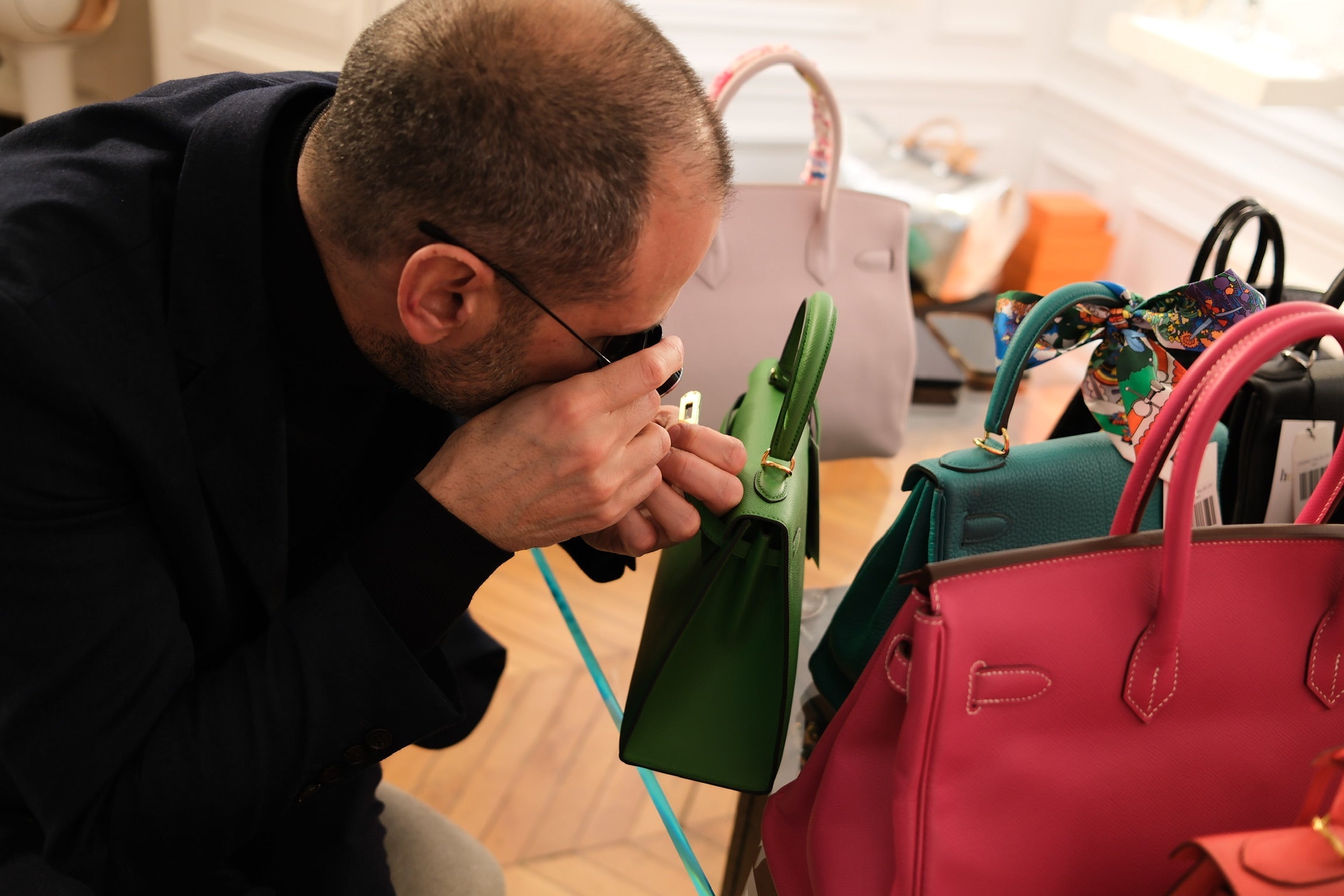


Understanding Hermès stamps
Dating a Bag and Better Understanding Its Story
At Hermès, every bag tells a story. One of the key elements to understanding it is the Hermès stamp, also known as the date stamp.
Discreet and sometimes difficult to locate, it nonetheless allows the year of manufacture to be identified — an essential piece of information on the second-hand market, both for authentication and valuation.
In this article, we explain what a Hermès stamp is, how to read it, and why it plays such an important role in the resale market.
What Is a Hermès Stamp?
The stamp is a letter (or combination of letters) hot-stamped inside a Hermès bag.
It indicates the year of production and may sometimes be accompanied by:
-
the artisan’s stamp,
-
a shape symbol (no frame, circle, or square).
Unlike many other luxury houses, Hermès does not use serial numbers, which makes an understanding of date stamps essential.

Why Is the Stamp Important on the Second-Hand Market?
The stamp makes it possible to:
-
precisely date a bag,
-
understand its production context,
-
identify certain changes in finishes over time,
-
reassure buyers when purchasing second-hand.
The year of production can influence a bag’s value, particularly for:
-
vintage pieces,
-
highly sought-after production periods,
-
iconic models in excellent condition.
The Different Hermès Stamp Formats
Over time, Hermès has used several stamping systems:
-
No frame: the earliest production periods
-
Letter inside a circle: from the 1970s to the mid-1990s
-
Letter inside a square: late 1990s to 2014
-
Single letter with no shape: since 2015
These evolutions also help verify the consistency of a bag with its stated year of production.
Hermès Stamp Reference Table (1945–2025)

Where Can You Find the Stamp Inside a Hermès Bag?
The stamp is generally located:
-
under the flap,
-
inside the bag near a seam,
-
behind a strap or leather tab.
Its exact placement varies depending on the model and the year of production.


Conclusion
The Hermès stamp is far more than a simple marking: it is a key reference point for understanding a bag’s age, authenticity, and sometimes its value.
On the second-hand market, knowing how to read it allows buyers to purchase with confidence and fully appreciate the history of each piece.
At Houlux, every bag is carefully examined, taking into account its stamp, condition, and provenance, in order to offer our clients complete transparency.